
Time to End Missouri’s Energy Monopoly
Missouri used to have some of the lowest electric rates in the United States, but in recent years, electric bills have increased at one of the fastest rates in the country.
Investor-owned utilities Ameren, Evergy, and Liberty have forecast significant future costs for ratepayers to fund new energy resources and build and maintain electrical infrastructure. Because Missouri does not allow competition with the utility, these monopolies can forecast what they need to build, set the price, and ratepayers pay these costs as well as the utilities’ return on equity (profit) without a choice.
There is another way.
There are 22 states that allow for full or partial competition with the utility so ratepayers have options. In 14 of those states, the utilities no longer own the generation or creation of electricity as a monopoly.
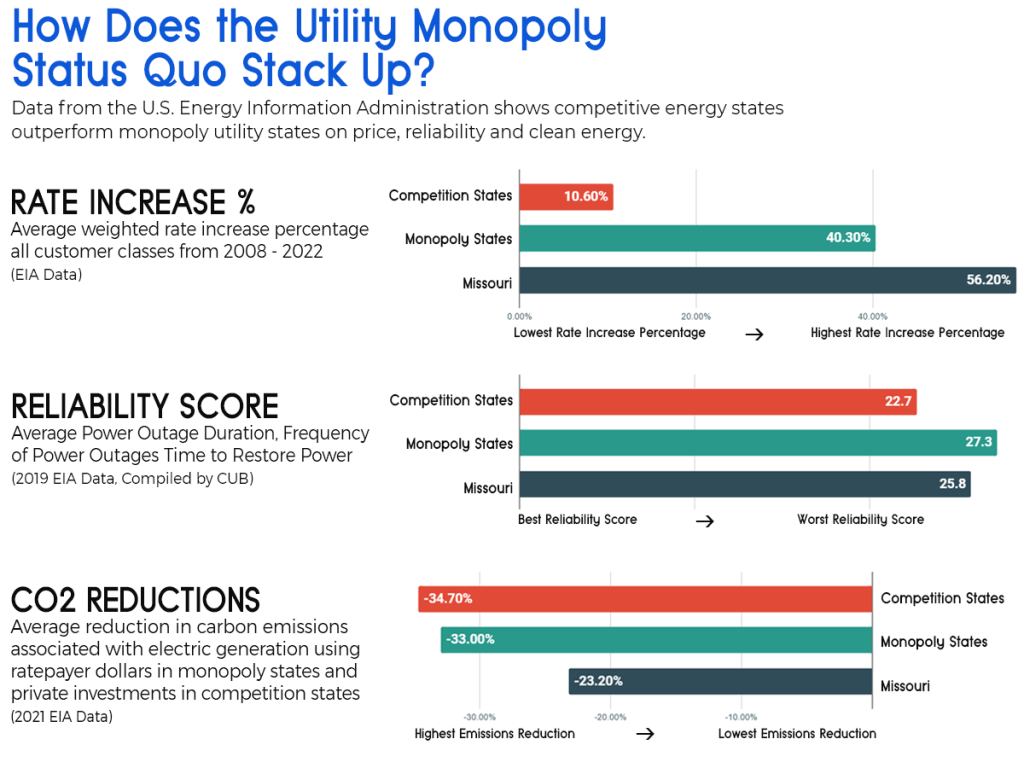
The investments in power plants and energy resources are paid for by private companies competing against each other to build the most reliable, in-demand, and efficient energy resources. The state’s electric ratepayers do not pay for these costs. These costs and the risk if they are not the best resource for demand and reliability fall on the private investor.
The price of electricity is rising across the country. Old energy resources are retiring, and new, cleaner, and more reliable resources are needed. In states that broke up the utility monopoly, rates have increased at a slower rate than monopoly states, with fewer carbon emissions and more reliable energy systems. All while giving customers a choice and access to a wide variety of energy plans and products.
Missouri’s ratepayers deserve energy choice
Rep. Don Mayhew, Rep. Tricia Byrnes, and Sen. Nick Schroer have introduced legislation (HB2207, HB2233, and SB1411) to break up the utility monopoly and bring competition to Missouri’s energy market. This legislation exempts and does not affect the electric cooperatives and municipalities.
Click here to add your name in support of this legislation and to stay updated on this issue.

